A statewide primary roster, in.
300 cite-able candidate profiles, out.
What would take a research team months of manual work — delivered in days.
Problem → Plan → Solution. You describe what you need, we respond with a detailed plan, and if you say go, we build the solution.
No credit card. The Plan delivered in 5 business days.
— A real estate construction lawyer
You publish a newsletter to readers who care about specific issues. A primary is coming. The candidate roster is hundreds of people across more than a hundred races. You'd love a research brief on each one — positions on the handful of issues your readers actually vote on, plus voting records for incumbents, plus sources every reader can verify. The research is essential. It's also too time-consuming for any one person, or any small team, to actually do. By the time you'd produce it, the primary's over. Handled rebuilt this entire pipeline as a done-for-you delivery: hand us your framework and the roster, get back a cite-able guide and a public site your readers can search.


Built by professionals, for professionals.TheAIMasters, LLC
What we built
View the live candidate guide→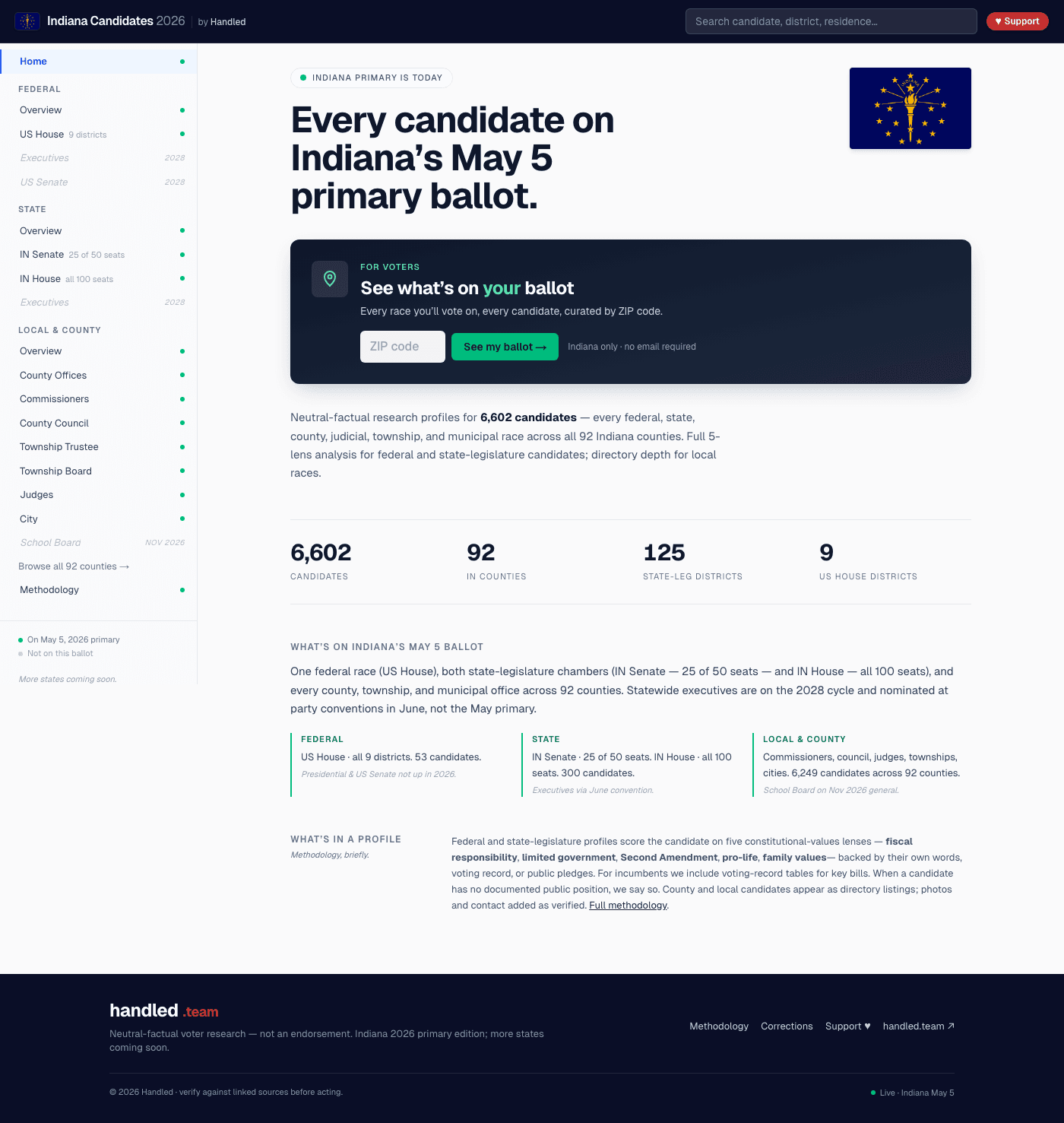
Sometimes you can’t see the whole solution at the start. So we refine until you can.
Most engagements take two or three rounds. The first delivery often points to what comes next — and we keep adjusting from there, at no extra cost, until you have something you’d actually use.
- Round 1The research report
What we delivered: A comprehensive candidate research document — every contested race, each candidate scored against the editor's five issue lenses, every claim sourced. Hundreds of pages, citation-checked, with an adversarial QA pass that caught a fabricated endorsement before it shipped.
What we learned: It was rigorous and complete — and far too long for any reader to navigate. A voter doesn't want hundreds of pages; they want the handful of candidates on their own ballot.
- Round 2The cite-able profiles
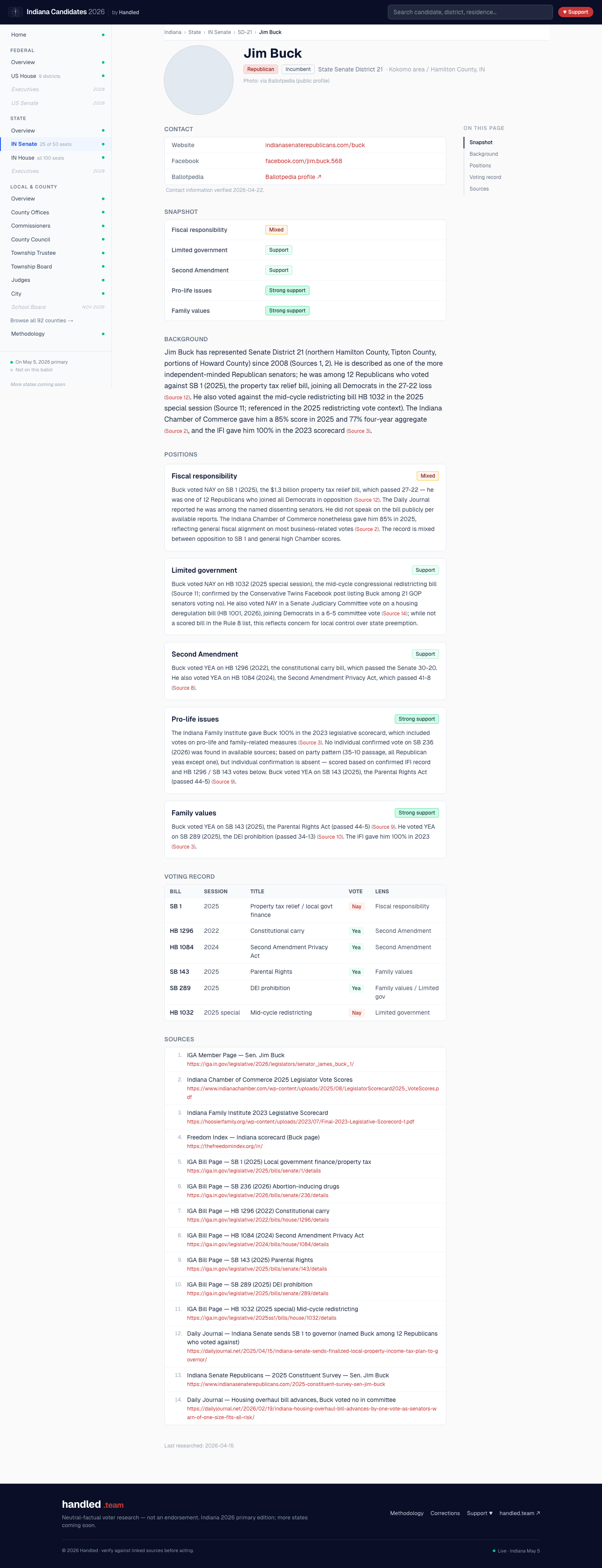
What we delivered: The same research restructured into per-candidate briefings — one scannable profile per candidate, five-lens scores with color coding, narrative, voting records for incumbents, and inline sources a reader can verify.
What we learned: Far more usable, but a reader still had to know which districts they were in to find their races. The work was findable only if you already knew where to look.
- Round 3 — this is what they useThe ballot-lookup site
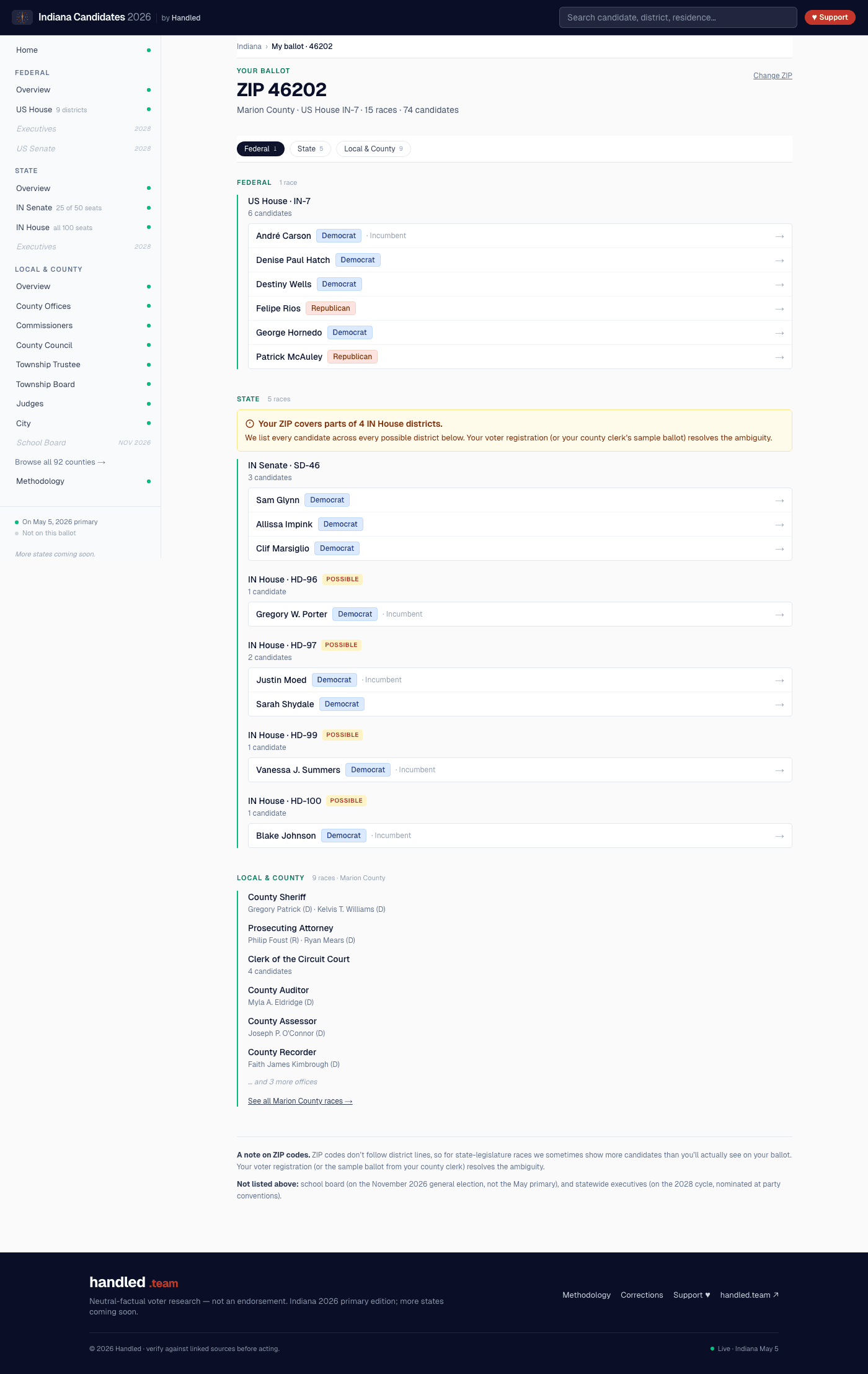
What we delivered: A searchable public site with ZIP-based ballot lookup — a reader enters their ZIP and sees every federal, state, and local race on their specific ballot, each linked to its cite-able profile. The dataset grew from 300 state-legislature profiles to more than 6,000 candidates statewide.
Why this landed: The guide became personal. A voter sees their own ballot in seconds, not a statewide directory they have to dig through. The research was always good; round 3 is what made it reach the reader on the day it mattered.
How we work.We iterate. The first round usually shows what we couldn’t fully see at the start — and we adjust from there. Refining is included; we keep going until you have something you’d actually use.
Once you’re using it, whatever we built stays available. Anything we built that breaks, we fix free, forever. And the more you use it, the more we learn how to improve it.
Maybe you’ve got this problem too
The same pipeline works whenever you have hours of recorded knowledge that nobody can find later.
Voter-education organizations
League-of-Women-Voters-style civic groups producing neutral candidate guides for general audiences. Same research rigor, framework you supply, no editorial position from us.
Advocacy newsletters in other states or future cycles
Same editor framework, swap roster. The pipeline is state-agnostic — if you can supply a values rubric and a candidate list, we can produce the guide. After this delivery, the same project expanded to thousands of federal and local races, and the framework ported cleanly.
Membership organizations with values-aligned voters
Trade associations, faith communities, professional bodies: any constituency where the framework is the editorial product and the candidate research is the bottleneck. We turn the framework into hundreds of cite-able profiles before the cycle ends.
How the subscription works.
Throw up to three problems at us at once — we work on all of them. Pay $1,500/month while we’re building or refining. When everything’s signed off, billing pauses automatically. A lifetime guarantee covers anything we built that stops doing what we said it would.
- 300 cite-able candidate profiles across 125 contested races (25 state-senate + 100 state-house districts), each scored against her five issue lenses with narrative and inline sources.
- Adversarial citation QA — a fresh-session gate that caught a fabricated national endorsement, demoted 13 over-inferred positions to honest "no public position found," and stripped 166 dead-link sources before delivery.
- Voting-record analysis for incumbents on lens-relevant bills, every figure tied back to a verifiable source.
- A searchable public site with district browsing, candidate search, ZIP-based ballot lookup, and a methodology page — later expanded from 300 profiles to more than 6,000 candidates statewide.
- Reusable data exports — a branded PDF, a 15,000-line markdown master, plus structured JSON and CSV for newsletter reuse. The data is yours.
Questions people ask.
Written by Gabriel Rymberg, Co-Founder, Handled. Last updated .MBA · Decades across enterprise and defense
Got an election cycle and a roster?
Describe the problem. Get The Plan in 5 business days. Decide whether to subscribe from there.